


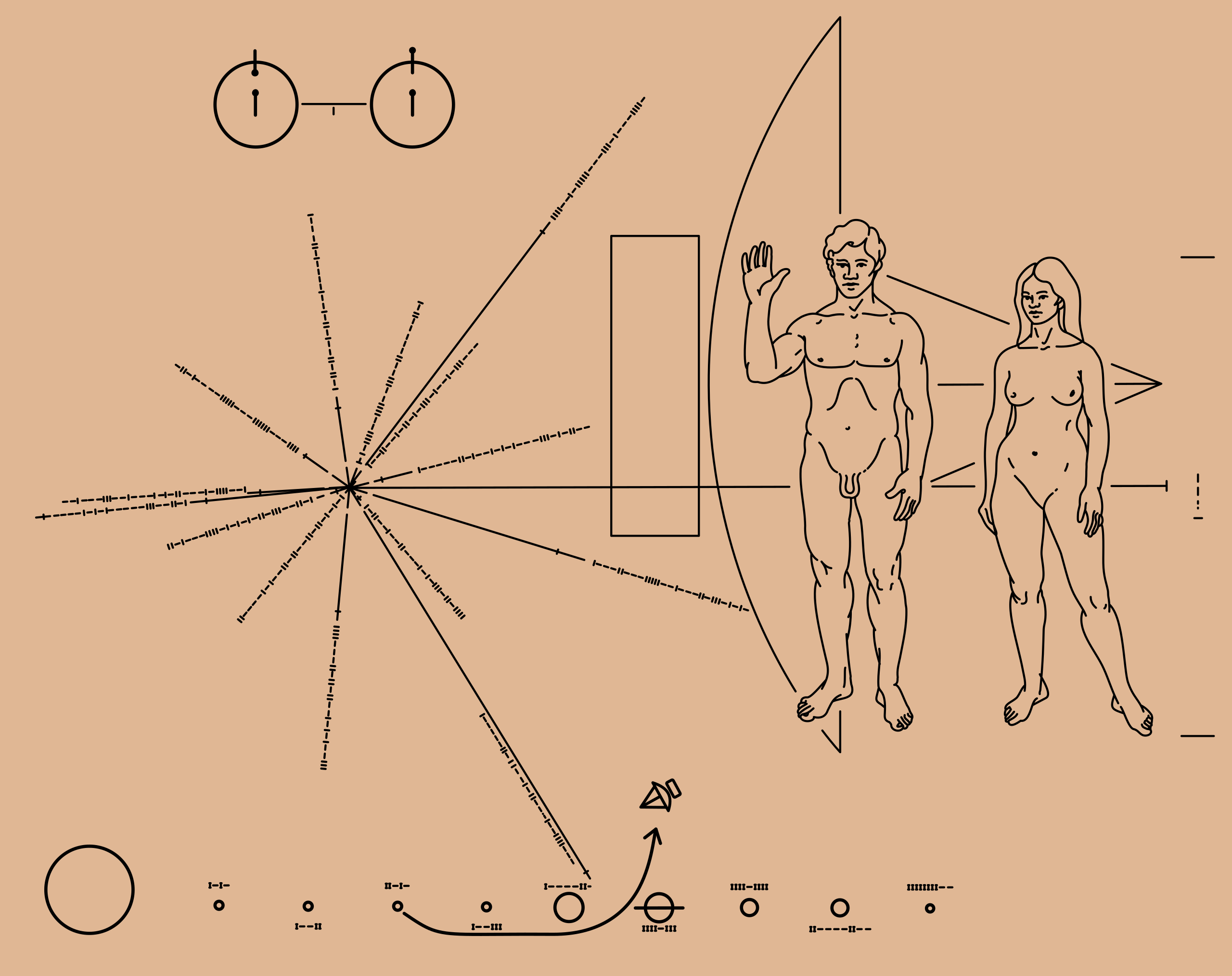
Archivo:Pioneer plaque.svg

Tamaño de esta previsualización PNG del archivo SVG: 757 × 600 píxeles. Otras resoluciones: 303 × 240 píxeles · 606 × 480 píxeles · 969 × 768 píxeles · 1280 × 1014 píxeles · 2560 × 2028 píxeles · 3063 × 2427 píxeles.
Ver la imagen en su resolución original ((Imagen SVG, nominalmente 3063 × 2427 pixels, tamaño de archivo: 53 kB))

Resumen
| Descripción |
English: The Pioneer plaque.
Français : Image de la plaque attachée au Pioneer, créée par la NASA.
Deutsch: NASA Bild der Pioneer-Plakette.
Español: Imagen de la placa colocada en la sonda espacial Pioneer, creada por la NASA.
Italiano: Immagine della placca del Pioneer 10.
Čeština: Destička umístěná na vesmírných sondách Pioneer 10 a 11 nese poselství o Zemi a lidstvu.
Русский: Пластинки «Пионера»
Português: Imagem da placa colocada na sonda Pioneer 10, criada pela NASA.
Suomi: Pioneer 10 -luotaimeen kiinnitetty laatta. NASAn kuva. |
|||||
| Fecha | ||||||
| Fuente | Vectorized in CorelDRAW from NASA image [1] | |||||
| Autor | Vectors by Oona Räisänen (Mysid); designed by Carl Sagan & Frank Drake; artwork by Linda Salzman Sagan | |||||
| Permiso (Reutilización de este archivo) |
|
|||||
| Otras versiones |
Original image by NASA |


Pioneer plaque gallery
Full
-
 Original
 -
 Transparent vector (.svg) format
 -
 Non-transparent vector (.svg) format

.svg)

Female and male
-
 Raster format
 -
 Vector format
 -
 Vector format silhouettes


.svg)
Female
-
 Transparent raster (.png)
 -
 Vector format
 -
 Vector format silhouette
 -
 Vector format silhouette


.svg)

Male
-
 Transparent raster (.png)
 -
 Vector format
 -
 Vector format silhouette
 -
 Vector format silhouette


.svg)

Other details


gallery of SVG pieces


gallery of PNG pieces




Historial del archivo
Haz clic sobre una fecha y hora para ver el archivo tal como apareció en ese momento.
| Fecha y hora | Miniatura | Dimensiones | Usuario | Comentario | |
|---|---|---|---|---|---|
| actual | 10:01 4 mar 2015 | | 3063 × 2427 (53 kB) | Medunta | I corrected the shapes of the characters in order to achieve 100% faithfulness to the original. The graph had to be redrawn because of errors in the vector and couldn't cleanly fix them because of the rotation. I slightly cheated on some elements in or... |
| 15:22 15 may 2012 |  | 2960 × 2326 (60 kB) | Mysid | code cleanup | |
| 04:05 30 jul 2010 |  | 2960 × 2326 (160 kB) | Mysid | valid svg | |
| 10:35 21 may 2009 |  | 2960 × 2326 (204 kB) | Mysid | complete redraw in Inkscape | |
| 10:58 5 dic 2006 |  | 2960 × 2326 (19 kB) | Mysid | ==Summary== {{Information |Description={{English}} The Pioneer plaque.<br/> {{Français}} Image de la plaque attachée au Pioneer, créé par la NASA.<br/> {{Deutsch}} NASA Bild der Pioneer-Plakette.<br/> {{Spanish}} Imagen de la plac |
Usos del archivo
Las siguientes páginas usan este archivo:
Uso global del archivo
Las wikis siguientes utilizan este archivo:
- Uso en af.wikipedia.org
- Uso en ar.wikipedia.org
- Uso en ast.wikipedia.org
- Uso en az.wikipedia.org
- Uso en bcl.wikipedia.org
- Uso en be-tarask.wikipedia.org
- Uso en be.wikipedia.org
- Uso en bg.wikipedia.org
- Uso en bn.wikipedia.org
- Uso en bs.wikipedia.org
- Uso en ca.wikipedia.org
- Uso en cy.wikipedia.org
- Uso en da.wikipedia.org
- Uso en de.wikipedia.org
- Uso en el.wikipedia.org
- Uso en en.wikipedia.org
- Communication
- Talk:Barsoom
- User:WhiteDragon
- Diagram
- User:Leandros
- User:Astronouth7303
- User:Ott
- User:NeonMerlin/boxes
- User:EJVargas
- User:Daviddukeuk
- User:Sagitox
- User:LaurenCole
- User:Hibernian
- User:Cparker
- User:Justox dizaola
- Wikipedia:Userboxes/Userboxes
- User:Maschinenjunge
- User:TangLung
- Depictions of nudity
- User:Riverdanceman
- User:UBX/contact reasons
- User:Hewhocutsdown
Ver más uso global de este archivo.

